
Interior Designing vs Architecture: Which Is the Better Career Choice in 2026?
April 17, 2026 2026-04-18 6:31Interior Designing vs Architecture: Which Is the Better Career Choice in 2026?
Every year, thousands of students finish their Class 12 boards and face a question their parents, teachers, and counsellors struggle to answer cleanly: Interior Design vs Architecture?
Both careers are creative. Both involve designing spaces that people live and work in. Both are growing fields with strong demand across India. But the course paths, eligibility requirements, day-to-day work, and career trajectories are genuinely different — and choosing the wrong one can cost you years.
This guide breaks down everything you need to know: what each field actually involves, how courses compare, what salaries look like in 2026, and — most importantly — a clear framework to help you decide which path is right for you.
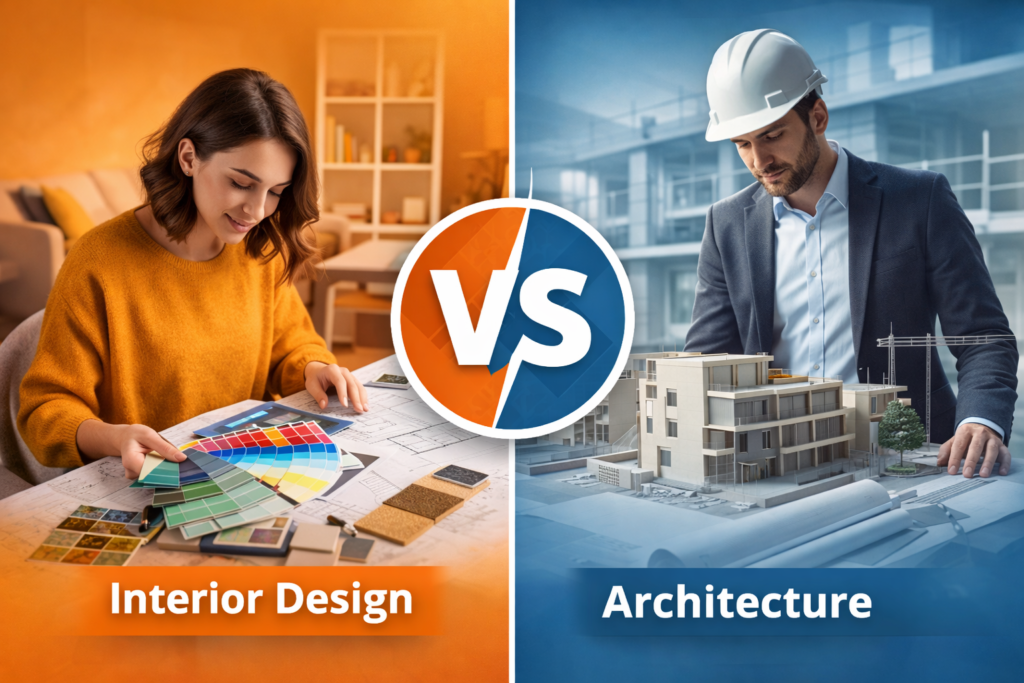
What Does an Interior Designer Do vs What Does an Architect Do?
The simplest way to understand the difference: architects design the building, interior designers design the experience inside it.
Interior Designers work with spaces that already exist — or are being built — to create environments that are functional, aesthetically considered, and suited to how people actually live and work. This involves choosing materials, planning spatial layouts, selecting furniture and lighting, coordinating with vendors, and managing the visual identity of a space across residential, commercial, hospitality, and retail contexts.
Architects are responsible for the overall design, structure, and construction of buildings. They work with structural systems, construction law, site analysis, environmental conditions, and urban planning frameworks. An architect’s work begins before a single wall is built and runs through every phase of construction and regulatory approval.
Where they overlap: both professionals need to understand spatial planning, human behaviour, and design principles. On larger projects, they work closely together — which is why some of the most sought-after professionals in 2026 are those who understand both disciplines.
Interior Design vs Architecture: Course Comparison
This is where the two paths diverge most sharply.
Interior Design: Most undergraduate Interior Design programmes in Hyderabad — B.Sc. or B.Des — are open to students from Arts, Commerce, or Science streams. Maths is not mandatory. Course duration is typically 3 to 4 years. Admission is generally based on portfolio reviews or aptitude assessments rather than a single national entrance exam, making it more accessible to students who haven’t followed the science-Maths track.
Architecture (B.Arch): Architecture requires a Science background with Mathematics as a compulsory subject. Students must also clear NATA — the National Aptitude Test in Architecture — which is mandatory for all B.Arch admissions across India. The B.Arch programme runs for 5 years, including studio work and mandatory internships.
If you don’t have Maths in your 12th, the B.Arch route is not available to you — but Interior Design absolutely is, and it’s a field with its own distinct professional standing and earning potential.
| Factor | Interior Design | Architecture |
| Course Duration | 3–4 Years | 5 Years |
| Eligibility | Arts / Commerce / Science (with or without Maths) | Science with Maths mandatory |
| Entrance Exam | Portfolio / aptitude test (varies by college) | NATA (mandatory) |
| Starting Salary | ₹2.5 – ₹4 LPA | ₹2 – ₹4 LPA |
| Senior Salary | ₹20 – ₹45 LPA (niche specialisation) | ₹14 – ₹22 LPA (metro cities) |
| Freelance Potential | High — client studios, Livspace, Homelane | High — independent consultancies |
| Registration | Voluntary (IIID certification) | Mandatory (Council of Architecture) |
Career Scope and Industry Demand in India 2026
The market data for both fields is genuinely strong — but the growth drivers are different.
Interior Design industry: India’s interior design sector was valued at USD 36.89 billion in 2025 and is projected to grow to USD 74.73 billion by 2034, at a CAGR of over 8%. This isn’t trend-driven growth — it is structural, fuelled by urban housing demand, commercial real estate expansion, and a generation of homeowners who have come to expect professionally designed spaces. Platforms like Livspace and Homelane have created entirely new employment structures for interior design graduates.
Architecture industry: The future of architecture in India is being shaped by smart city projects, green building mandates, climate-resilient infrastructure, and technology-led design workflows. Tools like BIM (Building Information Modelling), 3D visualisation, and AI-assisted planning are becoming standard in firms, and architects who combine design ability with technical expertise are seeing strong demand — particularly in tier-1 metro markets.
Emerging specialisations worth noting in 2026: sustainable design consulting, healthcare interior design, hospitality architecture, and interior architecture (a hybrid role that sits at the intersection of both fields).
Interior Design vs Architecture Salary in India
Both careers start at comparable entry-level pay — but they diverge significantly as you gain experience and specialise.
Interior Design: Fresh graduates typically earn between ₹2.5 and ₹4 LPA. Mid-level designers with 3 to 7 years of experience earn ₹5 to ₹8 LPA. Senior designers — particularly those specialising in luxury residential, hospitality, or healthcare design — can earn ₹20 to ₹45 LPA. Designers who build their own studios or consultancies can earn well beyond a salaried ceiling. Interior design offers a faster path to high earnings for those who specialise and build strong client networks.
Architecture: Entry-level architects start at ₹2 to ₹4 LPA. Mid-career professionals with 5 to 9 years of experience earn ₹4 to ₹12 LPA in firm roles. Senior architects in cities like Mumbai, Delhi, and Bengaluru command ₹14 to ₹22 LPA in salaried positions, with independent consultants earning considerably more. Architecture offers a more defined progression through firm hierarchies and the potential for landmark project credit.
Career Paths: Where Can You Actually Work?
Both fields open up a wide range of specialisations. Here’s what each looks like in practice:
Interior Design career options:
- Residential interior designer (homes, apartments, premium housing projects)
- Commercial and corporate interiors (offices, coworking spaces, tech campuses)
- Hospitality design (hotels, restaurants, cafes, resorts)
- Sustainable design consultant
- Kitchen, bathroom, and modular design specialist
- Set design for film, television, and exhibitions
Architecture career options:
- Interior architect (a hybrid role requiring knowledge of both disciplines)
- Architectural firm roles (junior architect through to principal architect)
- Urban and smart city planning
- Landscape architecture
- Sustainable and green building design
Interior Design or Architecture: How to Decide
Rather than telling you which career is ‘better’, here’s a framework that actually helps you choose based on who you are:
Choose Interior Design if: you don’t have Maths in your 12th, you’re drawn to aesthetics, materials, and the lived experience of spaces, you want to enter the workforce in 3 years rather than 5, or you’re interested in building a freelance or studio-based practice early in your career.
Choose Architecture if: you have a strong Maths and Science background, you’re interested in the structural and technical aspects of how buildings are designed and built, you’re comfortable with a longer academic commitment, and you want to work on large-scale infrastructure, urban development, or landmark projects.
Neither field is objectively better. The field that suits your skills, interests, and academic background is the one where you’ll build a stronger career — and 2026 has strong demand on both sides.
Why 2026 Is a Strong Time to Enter Either Field
India’s real estate market is in active expansion. Urban housing demand is outpacing supply in most tier-1 and tier-2 cities. The commercial sector — offices, retail, hospitality — is being redesigned for post-pandemic ways of working and living. Both interior designers and architects are in demand across these projects.
Sustainability is no longer optional in either field. Green building certifications, energy-efficient design, and climate-responsive architecture are becoming baseline requirements — creating premium niches for professionals who can demonstrate this expertise.
Technology is reshaping workflows across both disciplines. AI-assisted design tools, 3D visualisation platforms, and BIM software are now standard in competitive firms. Students who graduate with proficiency in these tools have a measurable advantage in the job market.
Start Your Design Career at Dhruva College of Design, Hyderabad
At Dhruva College of Design, we offer an Interior Design programme that prepares students for both the creative and technical demands of the profession. Our curriculum is built around studio practice, industry exposure, and the kind of portfolio development that employers and clients actually respond to.
If you’re exploring design as a career path after 12th — whether you’re drawn to interiors, architecture, or the space between the two — Dhruva’s admissions team can help you map the right course to your goals.
Explore the Interior Design Programme at Dhruva College of Design — Hyderabad. Applications for 2026 admissions are open.