10 Signs You Were Born to Be an Interior Designer
May 18, 2026 2026-05-18 9:2210 Signs You Were Born to Be an Interior Designer
Interior design is not just a profession. It is a deeply specific way of perceiving the world – one that certain people are born with and spend their entire lives doing automatically, long before they know it has a name. While most people walk into a room and register furniture and colour, an aspiring interior designer sees spatial proportion, the quality of morning light against a painted wall, the way a poorly placed sofa disrupts the emotional temperature of a room, and exactly what would fix it.
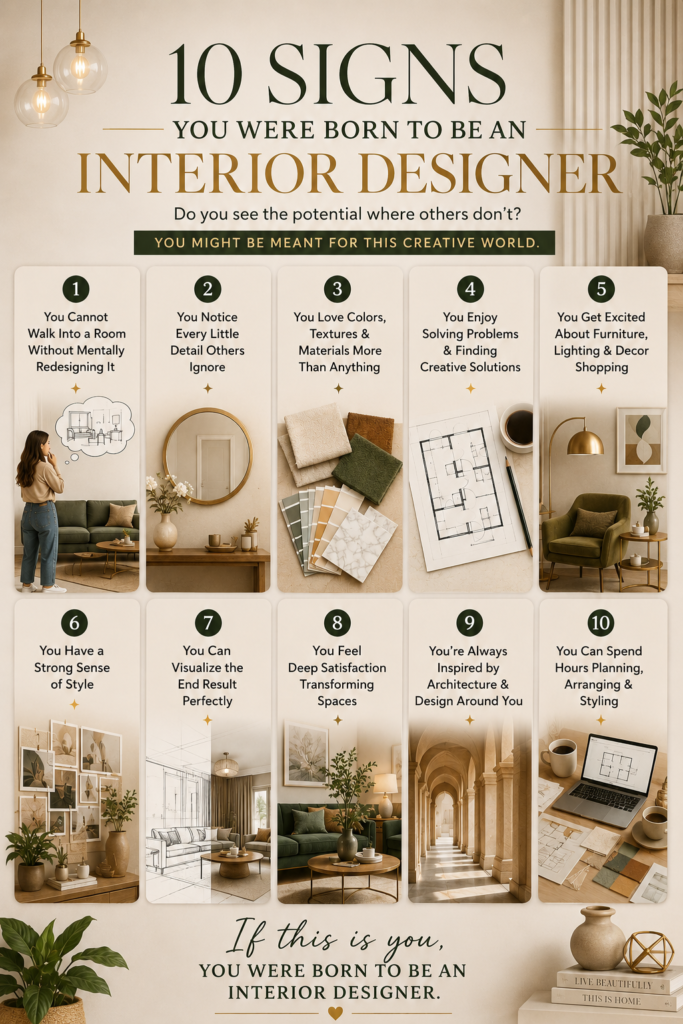
The question is not whether you like beautiful spaces. The question is whether your brain is already doing this work without being asked. Here are ten signs – grounded in what design educators across India observe in their strongest students – that interior design is not just an interest for you, but a genuine calling.
1. You Cannot Walk Into a Room Without Mentally Redesigning It
You walk into a relative’s drawing room in Hyderabad and within thirty seconds you have already moved the sofa away from the window, repositioned the TV unit so it does not dominate the entrance, and replaced the overhead tube light with something warmer.
You do this in restaurants, hotels, classrooms, and waiting rooms. You cannot help it. This instinctive and near-involuntary spatial correction reflex is one of the most reliable indicators that your mind is wired for interior design – and it is nearly impossible to teach to someone who does not already have it.
2. You Notice Light, Material, and Texture Before You Notice People
You enter a café in Banjara Hills and your first observation is about how the late afternoon sun comes through the frosted glass and falls across the concrete counter – not about the crowd or the menu. You are drawn to the difference between a matte clay-finish wall and a glossy enamel one.
You know what woven cane furniture feels like in a room before you touch it. This heightened material and sensory intelligence is exactly the foundation that interior design education builds upon, and students who arrive with it typically excel.
3. Your Phone’s Camera Roll Is a Design Archive
Open your saved posts on Instagram or your Pinterest boards right now. If the majority of what you have collected over the past year is home tours, apartment renovations, colour palette experiments, material close-ups, Bangalore studio apartments, or Hyderabad heritage bungalows – you have already been building a visual design education informally and consistently.
The best interior designers are the most dedicated visual learners, and you have been training your eye for years without realising it is training.
4. You Think in Colour, Mood, and Emotional Atmosphere
You do not see a wall as off-white. You consider whether a warm Jaipur terracotta or a cool Mughal-blue-inspired tone would change the emotional experience of the entire room.
You understand before anyone explains it to you that colour is not decorative – it is psychological. Students who arrive at design school already thinking in atmospheric and emotional registers – rather than just visual ones – tend to produce the most powerful and resonant interior design work.
5. You Are Comfortable With Both Creative and Technical Thinking
Interior design is a precise art. It requires both the imagination to conceive a spatial experience and the technical accuracy to document it as a working drawing, a material schedule, and a contractor brief.If you genuinely enjoy both the creative act – sketching, composing, imagining – and the structured discipline of technical thinking, you are built for a field that demands both simultaneously. The B.Des in Interior Design trains both capacities in parallel from the first semester.
6. You Are Fascinated by How Spaces Make People Feel
You have wondered why the reading corner of a particular library in your city feels calming while another feels sterile. You have noticed that some restaurants in Hyderabad’s Jubilee Hills make you stay for hours while others make you want to leave almost immediately after eating – and you have thought carefully about the design choices that produce this difference.
This curiosity about the relationship between built space and human emotion is not casual interest. It is the intellectual foundation of interior design as a professional discipline.
7. You Can Visualise Three-Dimensional Space Intuitively
When a friend describes a room, you can construct it in your mind with reasonable spatial accuracy. When you look at a basic floor plan, you can mentally walk through the space – feel the ceiling height, sense the proportion of room to window, understand the movement between zones.
This three-dimensional spatial intelligence is a natural cognitive asset that a formal design education at a studio-based institution like Dhruva will develop into a fully professional skill set through drawing, model-making, and digital visualisation.
8. You Have Strong, Reasoned Aesthetic Opinions
You are not simply someone who says ‘I like this’ or ‘I don’t like that.’ You have specific reasons. A round dining table works better in a particular room because it allows easier circulation and creates a more intimate dining dynamic.
That combination of timber and stone does not work because the tones are fighting rather than complementing each other. Strong aesthetic opinion grounded in spatial reasoning is design intelligence in its earliest form – and it is the raw material that formal education refines into a professional design language.
9. Creative Constraints Energise You
Interior design is almost never about ideal conditions or unlimited budgets. Most of the profession is about making a 600-square-foot apartment in Hyderabad’s Kondapur feel generous, or designing a corporate office on a constrained budget that still conveys brand ambition.
If the challenge of achieving something excellent within real limitations excites you rather than discourages you – if constraints make you more creative, not less – you are precisely the profile of person the interior design profession rewards most.
10. You Have Already Tried to Redesign a Space You Live In
You rearranged your bedroom layout twice in the last year. You have researched paint colours for a wall in your home even though no one asked you to. You have spent time thinking about how the family living room could be improved with a few deliberate decisions. This is not a hobby.
It is a practice. And with the right structured education – four years of rigorous studio-based learning – it becomes a profession that India’s rapidly growing real estate, hospitality, and commercial sectors are actively hungry for.
What to Do if You Checked Seven or More
Your instincts deserve a serious, accredited education. The Bachelor of Design (B.Des) in Interior Design at Dhruva College of Design, Hitech City Hyderabad is a four-year programme affiliated with Osmania University. Students develop a complete professional toolkit – AutoCAD, 3D visualisation, spatial planning, lighting design, materials knowledge, client management, and portfolio development – alongside creative studio practice grounded in real project briefs and industry mentorship. Admissions for 2025 are now open, and students from all streams are eligible.
Explore the B.Des Interior Design Programme | Dhruva College of Design, Hitech City, Hyderabad | Osmania University Affiliated | Admissions Open 2025
Frequently Asked Questions
Q: Do I need to have studied art or design in school to apply for B.Des Interior Design?
A: No. Students from Science, Commerce, and Arts streams are all eligible to apply for the B.Des in Interior Design at Dhruva College of Design. Admissions are based on a design aptitude assessment, not on your school stream or specific subject scores.
Q: Is interior design a good career choice in India right now?
A: Yes. The Indian interior design industry is projected to grow significantly over the next decade, driven by the residential real estate boom, the rapid expansion of the hospitality sector, and growing demand for designed commercial spaces. Trained and credentialed interior designers are consistently in demand across Hyderabad, Mumbai, Bengaluru, and Delhi.
Q: How is a B.Des in Interior Design different from a short course or online certificate? A: A B.Des is a four-year university-recognised undergraduate degree. It develops technical skills (AutoCAD, 3D visualisation, construction documentation), design thinking, and professional practice over an extended period of studio-based learning. Short courses and online certificates provide introductory awareness but do not qualify graduates for professional design positions or postgraduate study.
Explore the BBA in Family Business Management at Dhruva College of Design and Graduate Studies, Hyderabad — and take the first step towards becoming the leader your business needs.